

Moving House
A kind of torture

This article was inspired by an old column of Flann O’Brien’s, found in a book which I found in an old Dublin bookshop.

Gentle Reader,
I have a list on my phone of all the places I’ve ever lived. There are 20 addresses. 13 are in Ireland, 5 are in Australia, and 2 are in Italy. That means I moved house 19 times.
About 7 or 8 of those times were big moves, when I had to haul everything from one place to the next, unlike some of the easier moves, when you still leave half your stuff in your childhood bedroom, when you come home at weekends and your ma still does your washing and gives you food.
But every time I did a big move, I had the same thought: “How is it possible that I have accumulated so much rubbish in such a short space of time?”
Then a second, slightly guilty thought arises: “Imagine how much harder this would be if you had a wife and kids. Imagine moving them around. You actually have it quite easy.”
Such thoughts are in accord with the present writer’s tendency for self-flagellation.
The idea of ‘moving house’ actually has very little to do with moving a house, and a lot to do with hawking one’s belongings to a new abode, and I have come to realise it’s more of a process than an act. I ‘moved house’ again last year, although this time, I hope, semi-permanently, as I bought a place for the first time.

Before I moved out, I had to throw away all the rubbish.
Some of it was curious to apprehend: all the little loyalty cards, faded, which I thought I would use again, but used only once. There are secret wishes in such items. When I kept a loyalty card for a cafe, it told me that I harboured a silent desire to become the kind of person who goes for coffee there regularly; it did not eventuate.
After I fucked up my knee, I found it very hard to throw out sports equipment, to sell bikes, to throw away football boots, because doing so would throw away the last promise of reclaiming that version of the old me.
What about seven pens you find in a drawer? How many should I keep? Some are blue and some are black and some are other colours. Five seems reasonable.
What about the nice big desk that won’t fit where I’m going? If I sell it I won’t make half what it’s worth. My parents have space for it but then we have to talk about it: another resistance arises.
What about things that, conceivably, could come in useful again? How do I know whether I will, some fine day, need such and such an item?
I’ve been caught out more than once. Recently, I gave away a Google Nest, only to realise it was exactly what I needed, and they don’t make them anymore.
But you can get most things now, quickly. If you have a big house I guess you can keep everything, but it’s only worth it if its well organised and accessible. I’m in an apartment so I err towards throwing stuff out, unless it’s hard to replace.
What about single socks? Should they always get the bin? There’s a chance the other one of the pair could turn up under your bed. I discovered several sets of socks from the previous owner in the far reaches of the hot press (yes, Americans, we Irish have something call a hot press, and I love it). What about garden pots and hanging baskets? How many does one need? Will my green thumb re-emerge or fade away? Who knows.
And, being Irish, I was raised in a guilt-inducing kind of way. You can’t throw anything away because someone, somewhere in the world, conceivably could use it. It’s the correct intention but, dear reader, I took it to extremes:
Looking through my kitchen pantry, I realised I had brought the same jar of vegemite with me, from address 14 or 15 on the list , to every single new address, without opening it again since it’s glorious Australian days — and that was six years ago.
Had it expired? Yes. Did it taste fine? Yes (insofar as vegemite can ever taste ‘fine’). Did I throw it away? No.
This time, moving for the long haul, I threw all the bags on the floor and then spent a few months of elated fatigue designing and assembling and organising and so on. The amount of labour required was much higher than anticipated. And I realised that I hadn’t really thrown out all the stuff I should have thrown out: a renewed round of purging began.
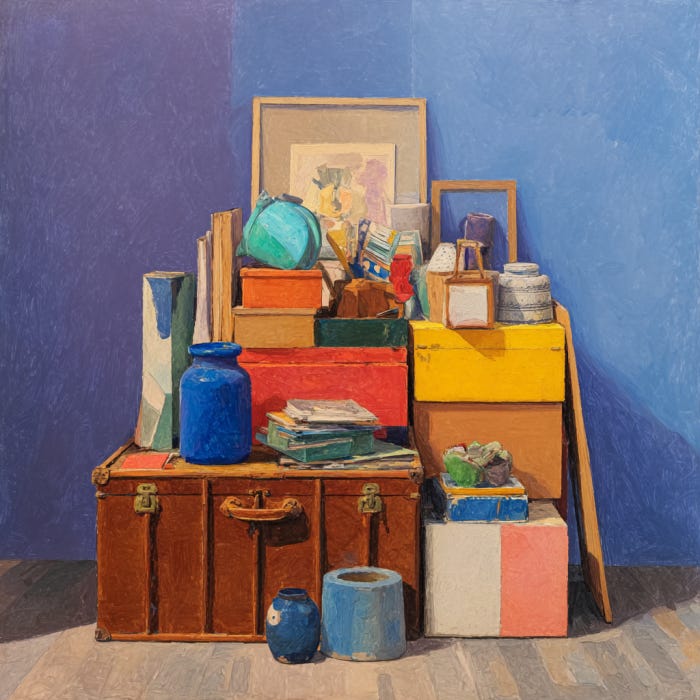
Then there was much moving of furniture and, subsequently, not moving it because you would be waiting for something to arrive. And then the something arrives and must be sent back because things are never right and a hole is left gaping in the living room which you can’t temporarily fill as you’ll only have to move things again.
Then there is the stuff which, after the experience of living in the actual place for a while, you realise you have put in the wrong place. Like my resistance bands and yoga mats and the single dumbbell which I have.
But they can’t go in their rightful place yet because the shelves and drawers and cabinets for the right place haven’t arrived yet. And the stuff which should go where the gym stuff is can’t go there, and there’s nowhere else for it to go, since I live in an apartment, now it’s in the hall, impeding the entrance and periodically tripping me up.
And once it’s organised, you’ll realise it doesn’t look good, and when it doesn’t look good, you’ll have to make it look good, which will disorganise it. And so on.
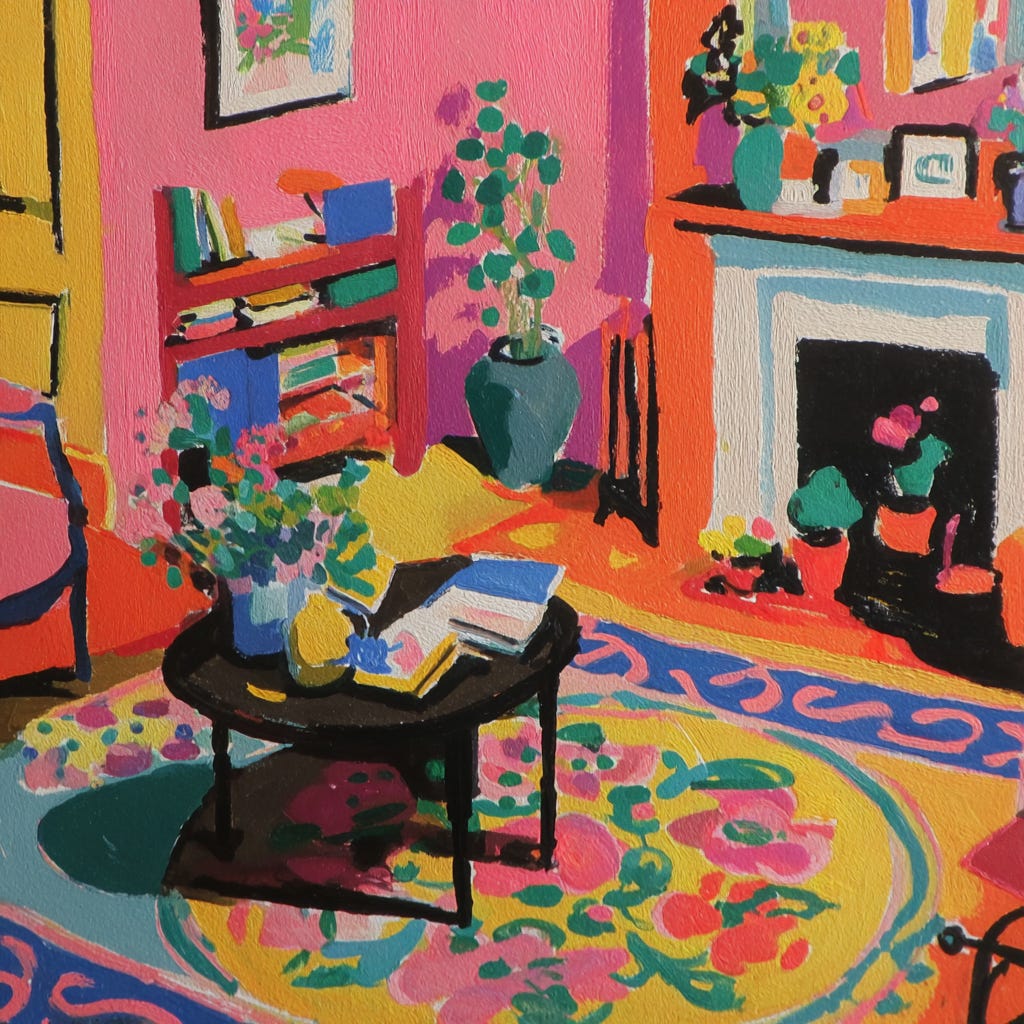
But it’s glorious, and there is a bedding in and a bedding down: you begin to find yourself. You can show who you are, to the world but to yourself. You can say: these are the books that I like: this is the art that I like: this is what I think should go on a hall table (potted plant, key bowl, hooks, sunglasses, coins, wallets, airpods, books, notebooks, a blue cap, swimming goggles hanging down). You can put books on every table and nobody will move them. You can design a whole environment. You can set yourself up for success.
And better still, outside the door, the faces of people begin to become familiar. The neighbour, the nice man at the grocer’s, the familiar couple from the local run club, the woman you did one reiki session with who salutes you warmly every time, the chatty guy at the cafe who may or may not be the owner.
You feel different, because you bought in. It makes you want to put down roots and it makes you want to put out feelers. You behave differently. This is the real gold.
And on a sunny day you begin to think: I love living here.
And the back of your mind pipes up and says: “Well good, because I’m not f****** moving again!”
Moving house is indeed a nightmare, further enhanced by the guilt of all the spending on defunct "stuff".
I can't think of anyone for whom moving is a good experience.
On that positive note, all best wishes for a successful move!